
Meta Ads vs Boosted Posts for UK Takeaways
Facebook ads for takeaways: when a boosted post is enough, when a UK shop should use Ads Manager, and how to read the result without inventing a return.
· Updated · S M Mahmud Hasan · 7 মিনিটের পড়া
Facebook ads for takeaways are not the blue Boost button under last night’s burger photo. That button can still be useful. It is a different tool from Meta Ads Manager, and UK shops mix them up because both put the same picture in front of strangers. This note is for an owner who wants collection or delivery orders from people near the shop, not a bigger like-count.
What Meta says the two tools are
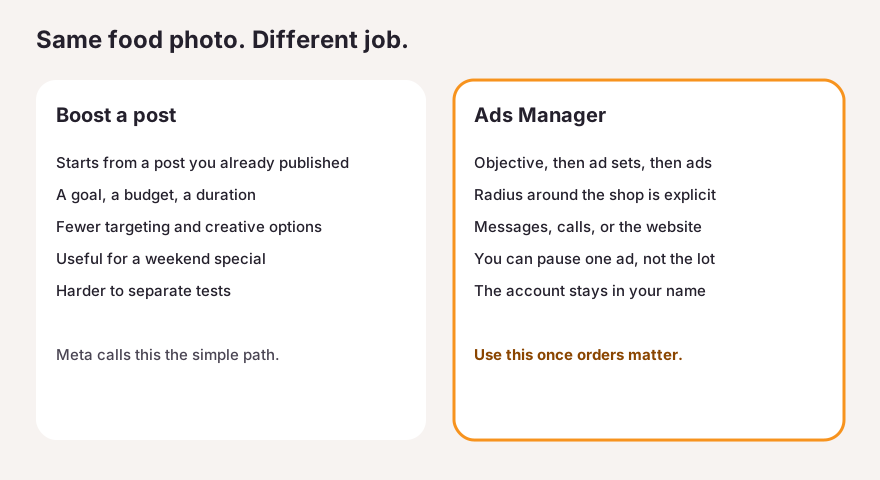
Meta’s help page on boosted posts and ads describes a boosted post as an ad you create from an existing post, Story or Reel on your Facebook Page or Instagram account. It is the simplest way to reach more people. The same page says boosted posts do not have as many customisation and detailed targeting options as a traditional Meta ad. When you boost, you still choose a goal, you can edit the text, and you pick placements, audience, budget and duration. The creative starts from the post.
A second page, Different ways to promote your business, says the Boost and Promote buttons are a reasonable start if you are new, and that Ads Manager is where you go when you want more control of goals, creative, placements and targeting.
Choosing a goal in Meta Business Suite draws the line in one sentence: Business Suite asks for a goal and guides the setup; Ads Manager asks for an objective and lets you build the campaign level by level. For a takeaway, that difference shows up the first week you try to answer “did the £40 buy collections, or did it buy likes?”
When a boost is enough
Boost the post if all of these are true.
- The photo and the offer are already right. You are not testing three headlines.
- The special ends on a date, such as a Friday night deal.
- You would be happy if the result is profile visits and a few messages, and you will read those messages yourself.
- You are spending an amount you can shrug off if the post is ignored.
A boost is a bad place to learn. You cannot easily run the same offer to two radii, or stop one photo while another keeps going, or see a clean split between new customers and people who already follow you. If the shop runs one offer a month and the owner answers Instagram personally, that limit is acceptable.
When the shop should be in Ads Manager
Move to Ads Manager if any of these are true.
- You want a result you can name: a message, a call, a tap on the menu, or a visit to the ordering page.
- You need a radius around the postcode, not “people interested in food” across the country.
- You have more than one photo and you want the weak one to stop.
- Someone else will ask, next month, what the money did.
Set the campaign up in the client’s ad account. The page, the pixel and the payment method should be the shop’s. A restaurant that cannot log in cannot check the work. Marketivity’s Meta Ads management is built that way: the ad budget is paid by you to Meta, and the management fee is separate.
A practical first campaign for a single-site takeaway is small on purpose. One objective. One area. Two or three ads that use the real menu, the real prices and a photo of the real food. Turn comments on if you can answer them the same day. If you cannot, send people to a short menu page or to WhatsApp, and say which one in the ad.
What not to target
Meta does not provide ethnic or racial targeting, and you should not try to rebuild it with lookalikes of a surname or a language proxy. A British takeaway’s local demand is geographic. People who live or work near the shop, people who already messaged the page, and people who visited the site are enough for a first month. If you want a Desi menu in front of a wider city, say so in the food photo and the first line of copy. The dish is the targeting. The ad account is not a census.
Special Ad Category rules are a different limit, mostly housing, employment and financial products. A curry is not those. You still cannot invent a sensitive category to get narrower local options. If Ads Manager warns you, read the warning. Do not click through it because a template said to.
How to read the result without inventing a return
Likes are not orders. Link clicks are not orders. A messaging conversation is not an order until a person took payment or booked a collection. Ads Manager will show the result you optimised for. If you optimised for messages, judge messages. If the client later counts paid orders in a notebook, label that count as the client’s count.
The only sales figure Marketivity states in public is client-reported: about 17–20 sales per messaging campaign on average, where the client counted the sales. It is an average across those campaigns, not a forecast for your shop, and it is not revenue or ROAS. We do not turn it into a promise on a proposal.
Meta’s learning phase note says an ad set usually leaves learning after about 50 results in the week after the last significant edit. A small takeaway budget may never see 50 orders in a week. That does not mean the campaign is “broken”. It means you should not edit it every morning, and you should not expect the delivery system to be stable. The longer note on budgets for Shopify-style shops is about the same 50-result line.
A simple month for a UK takeaway
Week one: confirm the page name, the hours, and the collection or delivery area in the ad text. Launch one campaign. Do not also boost five old posts “just in case”. Those boosts spend against the same people and make the report noisy.
Week two: read messages and the ads. Pause the photo that people ignore. Do not change the radius and the photo on the same day, or you will not know which change did the work.
Week three: if messages are real orders, keep the budget flat for another week before you raise it. If messages are “how much is delivery to the other side of the city?”, the offer or the area is wrong. Fix the words before you add money.
Week four: export the Ads Manager numbers and, separately, the orders the shop actually took from that ad. Put them in two columns. The gap between the columns is the thing to talk about, not a blended “ROI” cell.
If you want that run looked after, the path is the Meta Ads service or a short brief. If you also want the menu on a site you own, so the ad does not depend on a platform listing, read the direct-order note next.
What to put in the ad itself
The offer should survive a glance on a phone in a queue. Name the dish or the deal, the collection or delivery rule, and the shop area. “Tasty food, order now” is not a takeaway ad. It is a caption that could belong to any kitchen in the country. Prices help. If the price on the ad and the price on the counter differ, staff will hear about it before you see it in the report.
Photographs of the real tray beat a styled stock burger. If you use a phone, wipe the lens and shoot in the light you actually have. A dark photo with a heavy filter looks cheap in the feed and expensive in the invoice.
Add the hours if you are closed a day the neighbouring shops are open. Nothing wastes a message faster than “are you open?” when the ad did not say.
If you want that campaign built and read with you, start at Meta Ads. Bring the menu and the area. We will not start from a boosted post and call it a strategy document.
FAQ
Are Facebook ads for takeaways just boosted posts?
No. Meta describes a boosted post as an ad made from content you already published, with fewer options. Ads Manager is where you set an objective, a local radius and a result such as messages or link clicks.
Can I target a neighbourhood by ethnicity?
No. Meta does not offer ethnic targeting. Use a radius around the shop, people who already interacted with the page, and creative that shows the actual food.
How many orders should a boost produce?
We do not publish a forecast. The only sales line we state is client-reported: about 17 to 20 sales per messaging campaign on average, counted by the client. It is not a ROAS.